UPSC General Studies Paper IV (Ethics, Integrity and Aptitude) tests more than theoretical knowledge. It evaluates your understanding of ethical principles, administrative values, moral reasoning and ability to apply these concepts in practical situations.
Many aspirants study Ethics thoroughly but struggle to convert their knowledge into effective answers. The difference often lies in answer presentation, conceptual clarity, relevant examples and balanced analysis.
So, how can you write better Ethics answers in UPSC Mains?
Here are practical strategies to improve your GS-IV answer writing.
1. Understand What UPSC Expects
Before writing answers, understand the purpose of the Ethics paper. UPSC expects candidates to demonstrate:
- Clarity of ethical concepts.
- Understanding of moral and administrative values.
- Logical and balanced reasoning.
- Practical application of ethical principles.
- Sensitivity towards different stakeholders.
- Commitment to constitutional and public service values.
Your answer should demonstrate ethical understanding rather than simply reproduce memorised definitions.
2. Start with a Clear and Relevant Introduction
The introduction creates the first impression. Avoid unnecessarily long introductions.
You can begin an Ethics answer using:
A. Definition: Explain the central concept in simple language.
B. Thinker’s perspective: Use a relevant idea from a philosopher or moral thinker.
C. Constitutional value: Connect the topic with justice, equality, liberty or other constitutional principles where appropriate.
D. Real-life context: Begin with a short administrative or social example.
For example, if the question is about integrity in public administration, start by explaining integrity as consistency between values, principles and actions.
Keep your introduction focused on the question.
3. Use Relevant Examples
Examples make theoretical answers practical and easier to understand.
Build an example bank around:
- Public administration and governance.
- Education and healthcare.
- Social justice and inclusion.
- Environmental protection.
- Corporate responsibility.
- Disaster management.
- Everyday ethical dilemmas.
For example, while explaining empathy in administration, you can discuss how a public official listens to the concerns of vulnerable citizens before making a decision.
Use examples that directly support your argument. Avoid adding unrelated examples just to make an answer look impressive.
4. Use Thinkers and Philosophers Effectively
UPSC GS-IV includes moral thinkers and philosophers. Their ideas can strengthen your answers when used appropriately.
Some useful references include:
- Mahatma Gandhi – Truth and non-violence.
- Buddha – Compassion and the Middle Path.
- Aristotle – Virtue ethics.
- Immanuel Kant – Duty and moral principles.
- John Rawls – Justice and fairness.
- Swami Vivekananda – Character and service.
You do not need to quote every thinker in every answer. Understand their central ideas and connect them with the question.
A relevant explanation is more valuable than an incorrect or forced quotation.
5. Structure Your Main Body Properly
A well-structured answer is easier to evaluate.
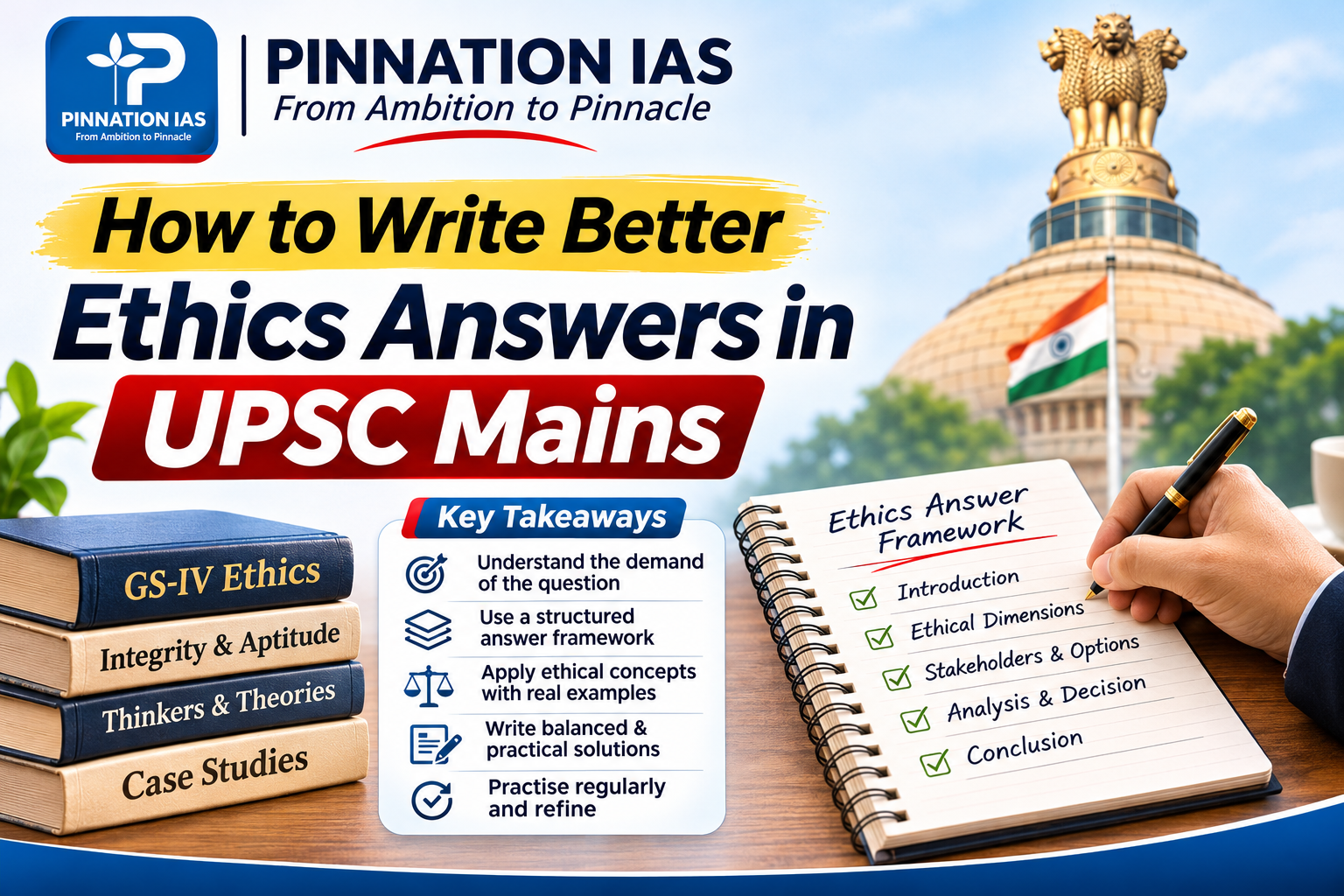
For most theory-based questions, use this approach:
Introduction: Define or introduce the concept.
Explanation: Explain the central idea and its dimensions.
Analysis: Discuss its importance, challenges, implications or applications.
Examples: Support your arguments with relevant examples.
Conclusion: End with a balanced and constructive perspective.
Use short paragraphs, headings and bullet points wherever they improve readability. However, avoid turning every answer into a list without explanation.
6. Develop a Balanced Conclusion
Your conclusion should answer the question and leave the examiner with a clear final thought.
You can conclude by connecting the issue with:
- Constitutional morality.
- Public welfare.
- Citizen-centric governance.
- Accountability and transparency.
- Ethical leadership.
- Justice and human dignity.
For example, an answer on accountability can conclude by explaining that transparent and responsible administration strengthens public trust.
Avoid introducing completely new arguments in the conclusion.
7. Practise Ethics Case Studies Separately
Case studies require application of ethical reasoning rather than theoretical explanation alone.
Use this six-step framework:
- Identify stakeholders: List the people and groups affected.
- Identify ethical issues: Highlight conflicting values and duties.
- List available options: Consider realistic courses of action.
- Evaluate alternatives: Assess legality, ethics and consequences.
- Choose a decision: Select a practical and ethically defensible option.
- Explain implementation: Mention safeguards, transparency and accountability.
Your decision should be lawful, impartial, humane and administratively practical.
8. Follow a Daily Answer-Writing Routine
Regular practice is essential for improvement.
A sample 60-minute routine:
| Activity | Time |
|---|---|
| Revise one Ethics concept | 15 minutes |
| Write two theory answers | 20 minutes |
| Practise one case study | 15 minutes |
| Review and improve answers | 10 minutes |
Practise within the prescribed word limits and time constraints. Gradually increase the difficulty of questions.
9. Analyse Your Answers and Improve
Writing answers without evaluation may not produce consistent improvement.
After every practice session, check:
- Did I answer the exact demand of the question?
- Is my introduction relevant?
- Are my arguments logically organised?
- Have I used suitable examples?
- Is my analysis balanced?
- Does my conclusion address the question?
- Did I complete the answer within the word limit?
Identify recurring mistakes and rewrite selected answers after reviewing them.
10. Common Mistakes to Avoid
Avoid these frequent mistakes in UPSC Ethics answer writing:
- Memorising definitions without understanding them.
- Using irrelevant quotations and examples.
- Writing lengthy introductions.
- Ignoring the actual demand of the question.
- Repeating the same arguments.
- Giving unrealistic solutions in case studies.
- Ignoring stakeholders and ethical dilemmas.
- Neglecting time management and revision.
Remember, clarity and relevance matter more than decorative language.
How PINNATION IAS Can Support Your Ethics Preparation
Improving GS-IV answer writing requires conceptual understanding, regular practice and constructive guidance.
The UPSC GS-IV Ethics, Integrity & Aptitude Programme at PINNATION IAS focuses on helping aspirants strengthen their understanding and practical application of Ethics concepts.
Under the mentorship of Parag Gupta Sir, Former Group-A Officer and Founder & CMD, PINNATION IAS, aspirants can explore structured guidance in Ethics preparation, answer writing and case study analysis.
For programme details:
PINNATION IAS – From Ambition to Pinnacle
Call / WhatsApp: +91 8826559062
Email: info@pinnationias.com
Website: https://www.pinnationias.com
Conclusion
Writing better Ethics answers is a skill that develops through conceptual clarity, structured presentation, relevant examples and consistent practice.
Understand the question, organise your thoughts, apply ethical principles and support your arguments with practical illustrations.
With regular answer writing and honest evaluation, you can make your UPSC GS-IV preparation more effective.
Think ethically. Write clearly. Decide responsibly.