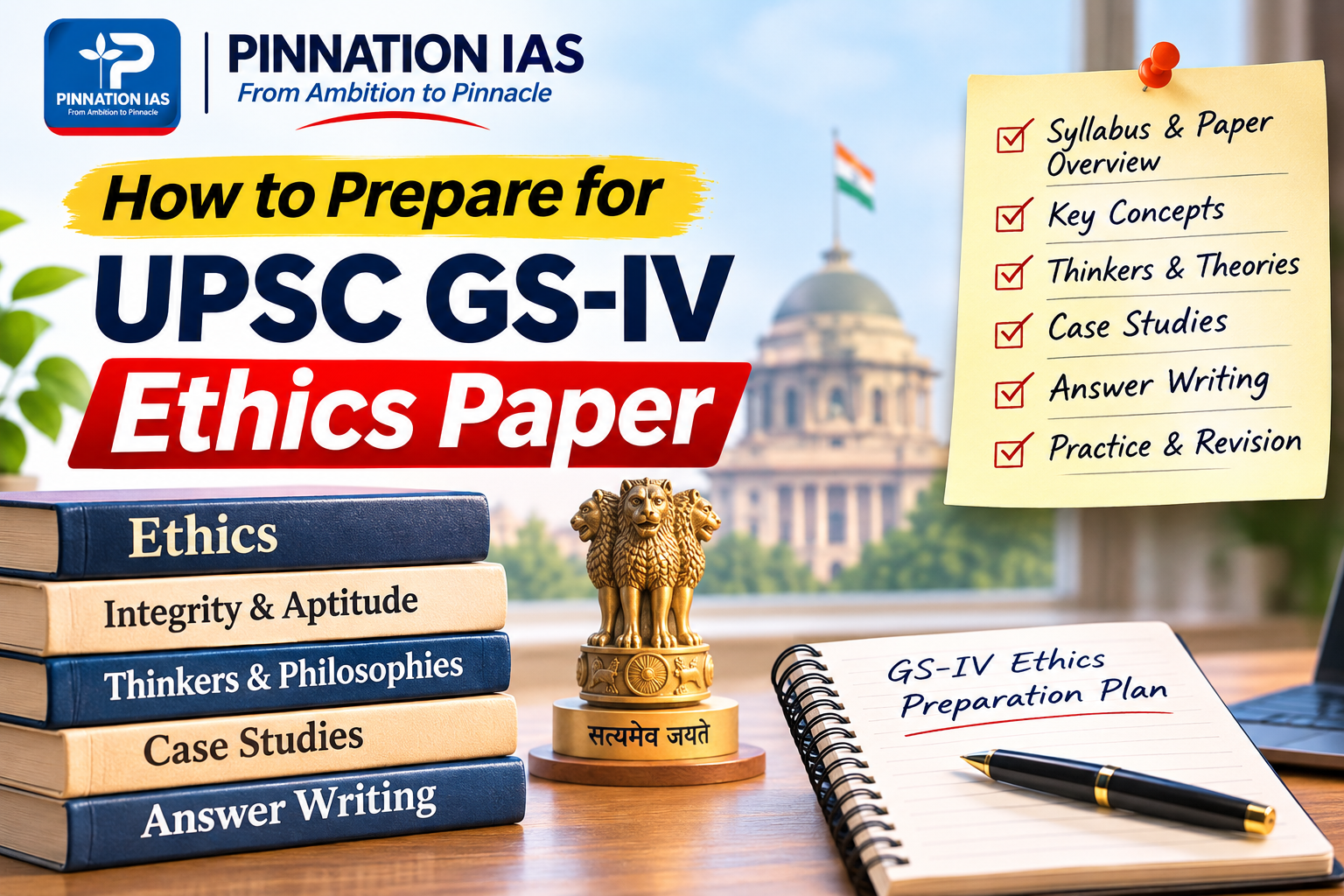
The UPSC Civil Services Mains Examination is not just a test of knowledge. It also evaluates a candidate’s judgement, integrity, attitude and ability to apply ethical principles in real-life administrative situations.
General Studies Paper IV, commonly known as the Ethics paper, plays an important role in assessing these qualities. It covers Ethics, Integrity and Aptitude, along with practical case studies related to public administration and decision-making.
Many aspirants find GS-IV challenging because it requires more than memorising definitions. You must understand ethical concepts, connect them with real-life examples and present balanced, practical answers.
So, how should you prepare for UPSC GS-IV Ethics?
Let’s understand a structured approach.
1. Understand the UPSC GS-IV Syllabus
Before starting preparation, carefully understand the syllabus. It is broadly divided into two sections:
Section A: Theory and Conceptual Understanding
Important areas include:
- Ethics and Human Interface
- Human Values and Lessons from the Lives of Great Leaders
- Attitude and its Influence
- Aptitude and Foundational Values for Civil Services
- Emotional Intelligence
- Contributions of Moral Thinkers and Philosophers
- Public/Civil Service Values and Ethics in Public Administration
- Probity in Governance
Section B: Case Studies
Case studies test your ability to apply ethical principles to practical situations.
Common themes include:
- Conflict of interest
- Ethical dilemmas
- Accountability and transparency
- Public service values
- Corruption and integrity
- Emotional intelligence in administration
- Stakeholder management
- Decision-making under pressure
Preparation tip: Do not study these topics as isolated definitions. Understand how each concept can be applied in administration and public life.
2. Build Strong Conceptual Clarity
Ethics preparation starts with understanding concepts clearly.
For example, you should be able to explain the difference between:
- Ethics and morality
- Integrity and honesty
- Accountability and responsibility
- Empathy and sympathy
- Attitude and aptitude
- Transparency and openness
For every important concept, prepare four things:
- Meaning and definition
- Explanation in simple language
- Practical administrative example
- Relevance to public service
This approach will help you write meaningful answers instead of reproducing textbook definitions.
3. Study Important Thinkers and Philosophers
UPSC GS-IV includes contributions of moral thinkers and philosophers from India and around the world.
Some important thinkers to study include:
- Mahatma Gandhi – Truth, non-violence and trusteeship
- Buddha – Compassion and the Middle Path
- Aristotle – Virtue ethics
- Immanuel Kant – Duty-based ethics
- John Rawls – Justice and fairness
- Swami Vivekananda – Character building and service
- Dr. B. R. Ambedkar – Social justice and constitutional morality
You do not need to memorise lengthy philosophical explanations.
Instead, understand each thinker’s central idea and learn how to use it in an answer or case study.
Example: Gandhi’s principle of trusteeship can be connected with responsible use of resources and ethical corporate behaviour.
4. Develop a Strong Answer-Writing Framework
Good content alone is not enough. Your answers must be clear, structured and relevant to the question.
A practical framework for a theory-based answer is:
Introduction
Start with a simple definition, relevant quotation, constitutional value or short example.
Main Body
Explain the concept through relevant dimensions, arguments, examples and administrative applications.
Conclusion
End with a balanced, practical and value-oriented conclusion.
For example, if the question asks about integrity in public administration:
- Define integrity.
- Explain why it matters for civil servants.
- Discuss its role in building public trust.
- Give an administrative example.
- Conclude with accountability and citizen-centric governance.
Practise writing answers within the prescribed word limit and time available.
5. Master Ethics Case Studies
Case studies are an important part of GS-IV because they evaluate practical ethical reasoning.
A common mistake is to jump directly to a decision without identifying the ethical issues and stakeholders.
Use this framework:
Step 1: Identify the stakeholders
Who will be affected by the decision?
Step 2: Identify the ethical issues
What values, duties or principles are in conflict?
Step 3: Identify possible options
List realistic courses of action.
Step 4: Evaluate each option
Consider ethical principles, legality, consequences and administrative feasibility.
Step 5: Choose the best course of action
Select a practical, lawful and ethically defensible decision.
Step 6: Explain implementation
Mention safeguards, transparency, accountability and follow-up.
Your answer should demonstrate empathy, impartiality, courage, fairness and commitment to public welfare.
6. Use Real-Life Examples in Your Answers
Examples make Ethics answers more practical and convincing.
Build an example bank around:
- Public administration
- Governance and public policy
- Social reform
- Education and healthcare
- Environmental protection
- Corporate responsibility
- Disaster management
- Everyday ethical dilemmas
Use examples only when they are relevant. Avoid forcing a quotation or personality’s name into every answer.
7. Practise Regularly with Previous Year Questions
Previous Year Questions help you understand UPSC’s expectations and recurring themes.
A useful practice routine:
- Analyse previous years’ GS-IV questions.
- Identify the syllabus topic behind each question.
- Prepare concise notes for recurring themes.
- Write timed answers.
- Review structure, relevance and clarity.
- Revisit weak areas and rewrite selected answers.
Do not rely only on model answers. First attempt the question yourself and then compare your approach with reliable explanations.
8. Create a Practical Daily Study Plan
Consistency is more useful than studying Ethics in long, irregular sessions.
A sample two-hour daily routine:
| Activity | Time |
|---|---|
| Concept study | 30 minutes |
| Thinkers and examples | 20 minutes |
| Answer writing practice | 30 minutes |
| Case study practice | 30 minutes |
| Revision | 10 minutes |
Adjust this routine according to your overall UPSC preparation schedule.
9. Common Mistakes to Avoid
Avoid these mistakes while preparing for GS-IV:
- Memorising definitions without understanding them.
- Ignoring the syllabus and studying randomly.
- Writing overly theoretical answers without practical examples.
- Using too many quotations without relevance.
- Giving unrealistic solutions in case studies.
- Ignoring stakeholders and ethical dilemmas.
- Not practising under time constraints.
- Failing to revise concepts and examples.
Remember, Ethics preparation requires conceptual clarity, practical judgement and regular writing practice.
10. How PINNATION IAS Can Support Your Preparation
Preparing for UPSC GS-IV requires a systematic approach to concepts, answer writing and case study analysis.
At PINNATION IAS, the UPSC GS-IV Ethics, Integrity & Aptitude programme is designed to support aspirants through structured learning and guided preparation.
Under the mentorship of Parag Gupta Sir, Former Group-A Officer and Founder & CMD, PINNATION IAS, aspirants can explore focused guidance for strengthening their understanding and application of Ethics concepts.
The programme approach focuses on:
- Conceptual understanding of Ethics, Integrity and Aptitude
- Practical application of ethical principles
- Case study analysis
- Structured answer writing
- Relevant examples and administrative perspectives
- Guided preparation and practice
For programme details, contact PINNATION IAS.
Call / WhatsApp: +91 8826559062
Email: info@pinnationias.com
Website: https://www.pinnationias.com
Conclusion
UPSC GS-IV Ethics is not simply about learning definitions or memorising quotations. It is about developing the ability to think ethically, analyse complex situations and make balanced decisions.
Understand the syllabus, build conceptual clarity, study important thinkers, practise answer writing and solve case studies regularly.
With a disciplined preparation strategy and consistent evaluation, you can strengthen your performance in the Ethics paper.
PINNATION IAS – From Ambition to Pinnacle.